
Educational Objectives
By the end of the course, participants will be able to:
- Understand detailed head and neck anatomy including muscles, nerves, and vessels
- Perform guided dissection of major organs
- Identify anatomical structures and spatial relationships
- Apply anatomical knowledge to clinical and surgical practice
- Strengthen confidence in anatomical identification
Program Structure
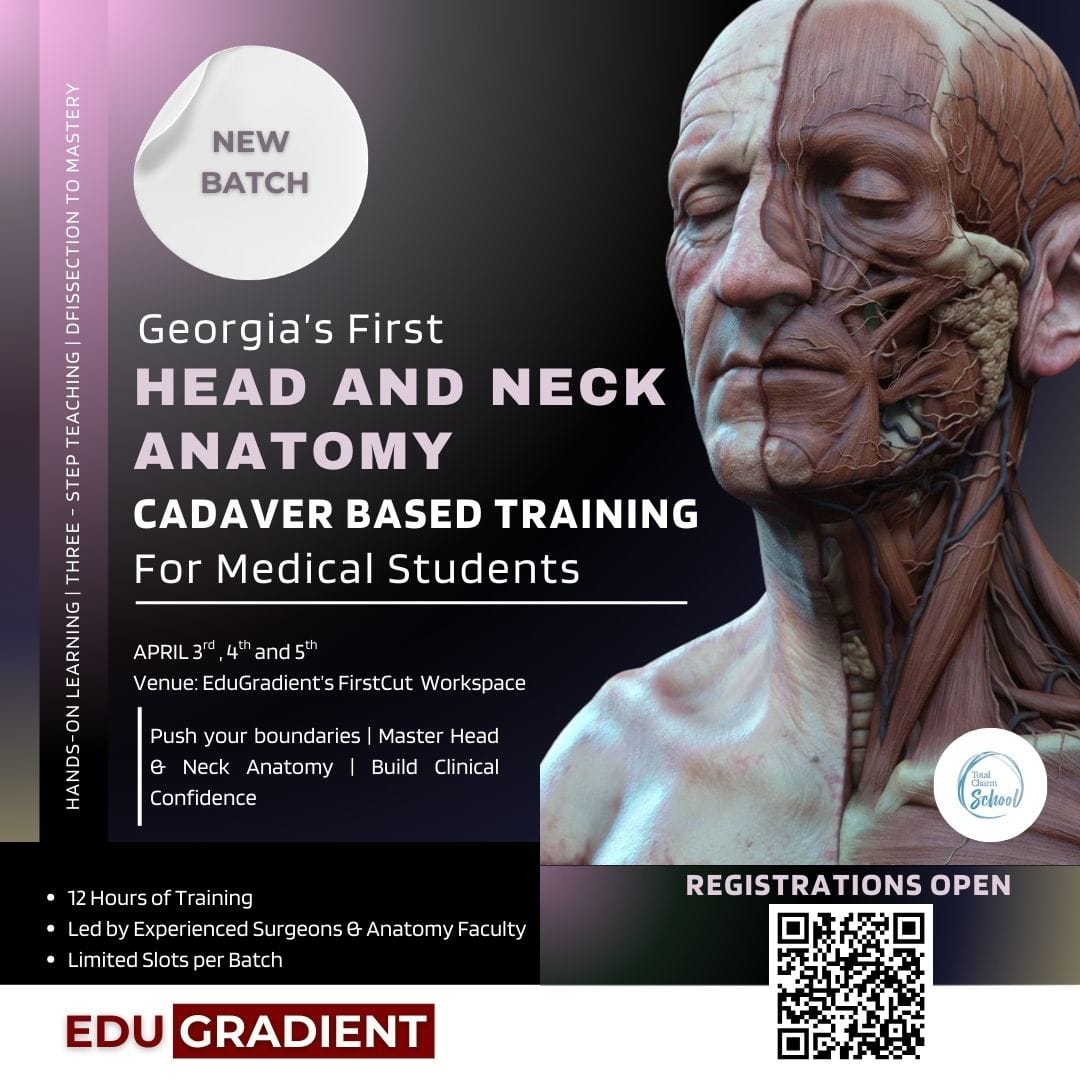
Duration: 3 Days
Dates: April 3rd, 4th, and 5th
Day 1 — Head & Neck Anatomy
Faculty: Dr. Shota Gogia
Activities include:
- Lecture on cranial and facial anatomy
- Study of facial musculature
- Major neurovascular structures
- Clinical anatomical applications
Guided cadaver exploration including:
- Skin and superficial fascia
- Muscles of facial expression
- Skull base structures
- Cranial nerves and branches
Day 2 — Organ Dissection
Participants will perform structured dissection of major organs including:
- Heart — chambers, valves, major vessels
- Lungs — lobes and bronchial tree
- Kidneys — cortex, medulla, renal vessels
- Spleen — hilum and internal structure
- Liver — lobes and biliary anatomy
Workshop stations include:
- Step-by-step dissection guidance
- Anatomical identification and labeling
Day 3 — Comparative Anatomy Session
Venue: Total Charm Anatomy Lab
Participants will examine two human head specimens:
- Specimen A — Complete head with intact facial structures
- Specimen B — Skull with soft tissues removed
This session allows participants to compare intact anatomy vs skeletal structure, improving spatial anatomical understanding.
For Queries & Enrollment Support
📩 info@edugradient.com
Final Note
This program offers a rare opportunity to learn anatomy through structured cadaver training and expert guidance, bridging theoretical knowledge with real anatomical understanding.
Reviews
There are no reviews yet.